At the 2026 IPF Opening Plenary, leaders from New York, Congress, and the American offshore wind supply chain emphasized a common theme: durability. As the U.S. offshore wind industry shifts from early ambition to real-world deployment, speakers called for revised market structures, infrastructure, and partnerships designed to last through uncertainty and deliver long-term value.
The Plenary opened with remarks from Oceantic CEO and President, Liz Burdock, who emphasized that this year represents a defining moment for America’s offshore wind industry, and called on attendees to work together “reimagine, renew, and reignite.”
A Moment of Proof for New York
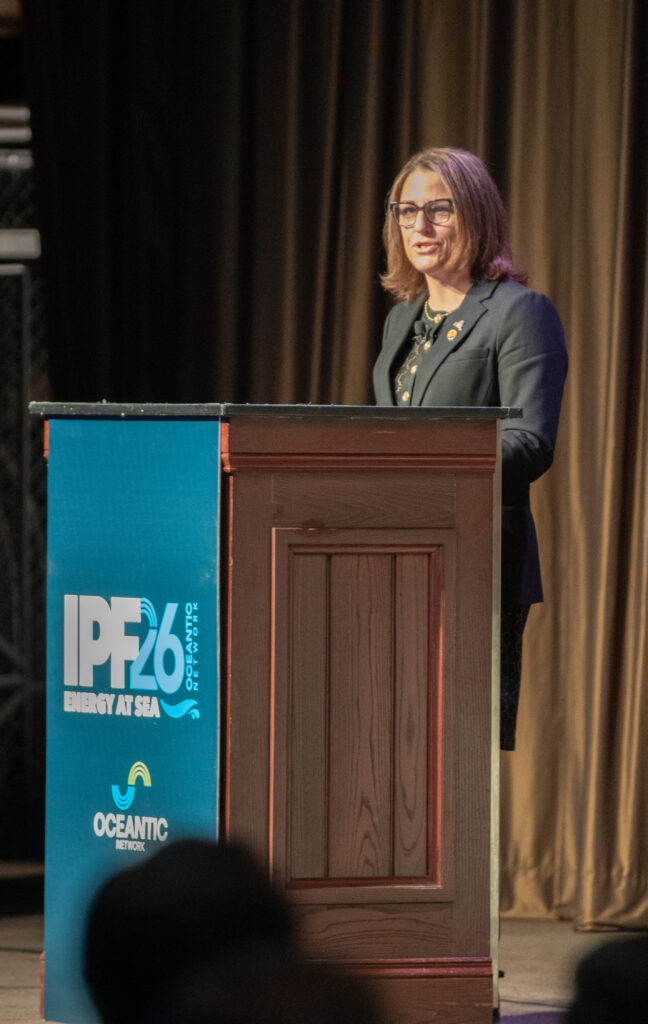
As the opening keynote, NYSERDA President and CEO Doreen M. Harris delivered a clear message: offshore wind in New York is now real, operating, and delivering when it matters most. With the state’s first project generating year-round power—including during a recent storm—and two additional projects under construction that will serve roughly 10% of New York City’s demand, Harris emphasized that New York’s commitments are paying off in tangible ways. Thousands of union workers are employed across the supply chain, including at the new Long Island marine terminal.
New York’s newly completed energy plan lays out a 15-year vision focused on resource diversity, resilience, affordability, and reliability. With electricity demand expected to grow 25% in the coming years, Harris highlighted offshore wind as a cornerstone of the near-term energy mix, alongside water and solar.
But progress hasn’t been linear. “It has been a year we could not have anticipated,” she said, noting that the state has adjusted its approach without abandoning its fundamentals. A new RFI seeks ways to accelerate readiness to keep a steady pipeline of projects moving.
For Harris, durability is as much about economic competitiveness as energy reliability. Stable policies shape where capital flows and where workers build careers. New York aims to remain a consistent partner—a “port in the storm”—committed to building an energy system that performs under real-world conditions, not idealized scenarios.
Why “Copy and Paste” Doesn’t Work
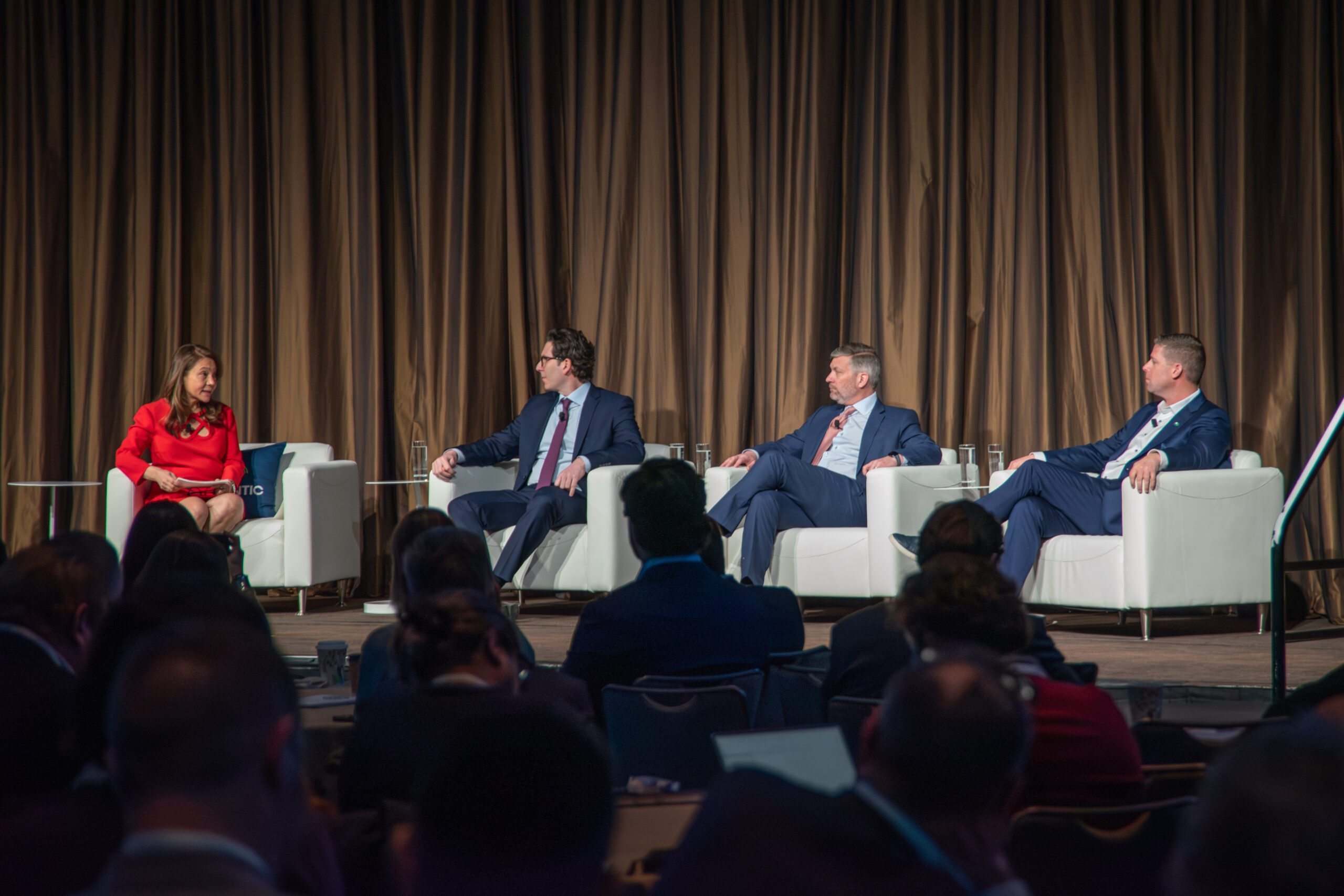
The Opening Plenary panel tackled a question facing every U.S. market leader: why can’t we simply replicate Europe’s offshore wind playbook?
The answer: different context and different constraints.
NYSERDA’s Georges Sassine (Senior Vice President, Large-Scale Resources) noted that early tools like Offshore Renewable Energy Certificates (ORECs) were essential to stabilize first-mover projects, but U.S. markets operate under overlapping federal and state authorities, making direct model transfers difficult. Now, with operating projects and more on the way, New York and other states are reassessing what must evolve for the next phase.
Transmission also emerged as a core challenge. Will Hazelip, President of National Grid Ventures stressed that successful projects treat offshore wind as energy infrastructure, not just electricity generation. Fragmented permitting and jurisdictional overlaps continue to complicate grid integration, even as states like New York make progress on onshore upgrades.
Panelists agreed the U.S. needs stronger regional coordination, particularly as global supply chains tighten and Europe doubles down on investment. The early “race” among states to secure supply chain assets is giving way to recognition that shared infrastructure and multipurpose ports will ultimately deliver more durable outcomes.
Risk allocation must evolve as well. States are increasingly unwilling to absorb open-ended premiums. George emphasized a necessary shift from risk-sharing to de-risking—creating conditions where projects succeed without requiring outsized public exposure. As Billy Haugland, CEO and President of Haugland Group, put it, the U.S. needs a clear and aligned “game plan” to reduce uncertainty across the value chain.
Steadfast Commitment and Lessons Learned
Commissioner Amanda Lefton of the New York State Department of Environmental Conservation closed the Plenary with reflections on how to build longevity into the U.S. offshore wind system.
Lefton highlighted four lessons:
- Defensible permitting that stands up over decades.
- Flexibility to accommodate new technologies.
- Market preparation, exemplified by NYSERDA’s work to shape durable conditions for investment.
- Steadfast commitment, even amid uncertainty.
“Offshore wind is an inevitability,” she said. “It’s not if—it’s when.”
The Path Forward
Across the Opening Plenary, speakers reinforced that durability of policy, infrastructure, supply chain, and partnerships is the guiding principle for offshore wind’s next chapter. With operating projects, a maturing workforce, and clearer alignment across states, the industry is better positioned than ever to build an offshore wind system that works under real-world constraints and serves communities for decades to come.
Get more 2026 IPF insights here.