Skepticism around offshore wind is not just coming from the margins. It is an increasingly frequent target of opposition groups for mainstream misinformation and centers on a familiar set of concerns: cost, reliability, jobs, and community acceptance. Those concerns framed a recent discussion among labor leaders, policymakers, and industry executives, and the message was clear: Offshore wind has moved beyond projections. Real data now exists, and it matters.
The industry’s supply chain has progressed rapidly. What began with uncertainty and skepticism has evolved into execution supported by data and experience. Five commercial-scale offshore wind projects are simultaneously under construction in the U.S., each contributing to a growing base of domestic expertise. Along the way, the industry has built new installation methods, training systems, and port infrastructure while navigating complex permitting and environmental requirements. American businesses supporting this sector now span 40 states and have driven more than $25 billion in private investment.
Performance data is also replacing projections. Operating projects are demonstrating how well offshore wind performs under real-world conditions, particularly during winter periods when electricity demand is high and the grid is most strained. In the Northeast, offshore wind’s strong winter capacity factors reduced reliance on expensive fossil fuels, stabilizing energy prices and saving communities money when they feel these cost pressures most acutely.
The rising cost of energy remains a central concern, but it is not unique to offshore wind. Demand is increasing, and states are grappling to meet it. And offshore wind can deliver today, with 7.5 GW of shovel-ready projects that can be built by 2031. Like other emerging industries, early projects absorb higher costs that decline as supply chains mature and processes improve. The current slowdown offers an opportunity to refine procurement strategies, improve cost structures, and recalibrate risk allocation. What the industry needs most now is predictability; in policy, permitting, and timelines.
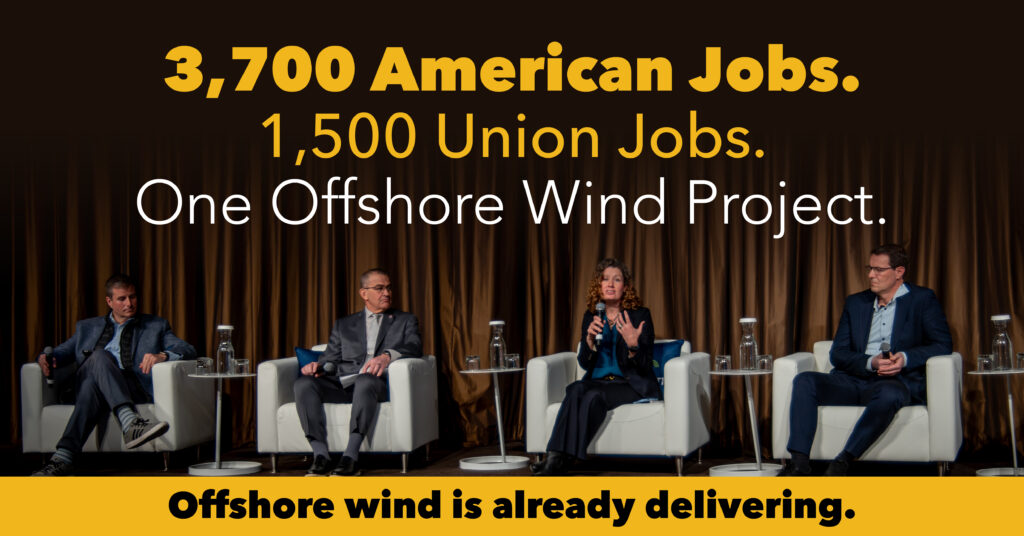
One of the most tangible pieces of evidence is the impact on America’s workforce. A single offshore wind project created 3,700 American jobs, including 1,500 union jobs (full report online). Behind those figures is a dedicated investment in people. Offshore wind workers undergo roughly 225 hours of specialized training before deployment, developing skills that are transferable and hard-earned. The risk today is not a lack of labor demand, but continuity of work. A gap between projects could mean losing a highly trained workforce that took years to build, undermining availability, efficiency and safety when activity resumes.
Right now, offshore wind is defined by hard numbers: jobs created, steel installed, energy delivered, and lessons learned. The data exists, industry dedication isn’t wavering, and state demand for offshore wind energy remains strong. Bipartisan permitting reform is the next critical step to ensure manufacturers, shipyards, and skilled workers aren’t forced to sit idle, raising costs and delaying benefits for millions of residents.
This is part of a 2026 IPF recap series, read more at www.oceantic.org.